Water damage almost never happens at a convenient time. A pipe bursts at 2 a.m., a dishwasher floods the kitchen on a holiday weekend, or a slow leak finally shows itself as a brown stain on the ceiling. In Montgomery County and across the Greater Houston area, where humidity is high and storms can hit hard, water damage moves fast — and so should you.
With 20+ years of restoration experience in The Woodlands Texas region, the team at Dri-Tex Restoration has walked into thousands of homes during the worst day of someone's week. The patterns are consistent: the homeowners who act calmly and follow the right first steps almost always have smaller bills, smoother insurance claims, and shorter recovery times. The ones who freeze, wait, or try the wrong DIY fix often spend two to three times more by the time we arrive.
This guide walks you through exactly what to do first after discovering water damage in your home — in the order it actually matters.
Why the First Hour After Water Damage Matters Most
Water damage is a timeline problem before it is a repair problem. Within the first 24 to 48 hours after a leak or flood, untreated moisture begins to soak into drywall, baseboards, subflooring, and insulation. Mold spores, which are already present in every home, only need moisture and time to start colonizing porous materials. In Conroe's warm, humid climate, that window can be even shorter.
The good news: most of what happens in those first hours is in your control. You do not need special equipment to take the first six steps below. You just need to know the order — and you need to make the right phone calls quickly.
Step 1: Stop the Source of the Water Immediately
Before you mop up a single drop, shut off the water. Every minute of continued flow is more damage.
If the source is plumbing inside your home (a burst pipe, leaking supply line under a sink, water heater rupture, or running toilet), turn off the localized shut-off valve if you can see one. If you cannot, go straight to the main water shut-off for the house. In most Texas homes, the main valve is located near the front of the property, often near the hose bib, in the garage, or at the meter near the curb.
If the source is an appliance (dishwasher, washing machine, refrigerator water line, ice maker), shut off the dedicated valve behind the unit. If there is no accessible valve, shut off the main.
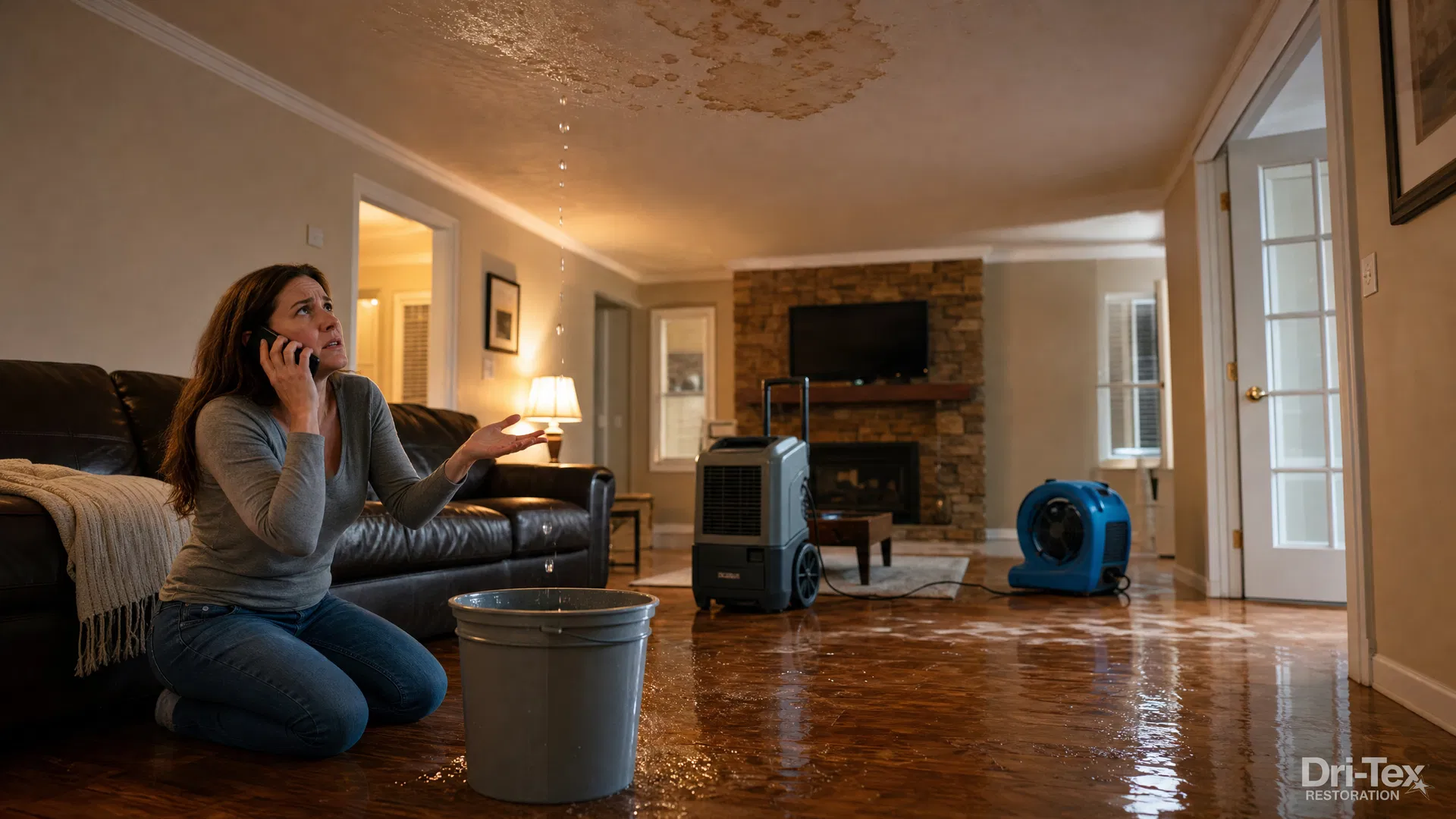
If the source is the roof or storm-related, you obviously cannot stop rain — but you can place buckets under active drips, move furniture away from the area, and pull rugs back from the affected floor.
Real example: A homeowner in Montgomery called us after a supply line under her kitchen sink failed while she was at work. Her dog had been barking on the camera for two hours. By the time a neighbor entered to shut off the main, the kitchen, dining room, and part of the living room subfloor were saturated. Total mitigation cost: roughly $14,000. Had the main been shut off in the first 15 minutes, our estimate for the same job would have been closer to $3,500. Knowing where your shut-off is — before you need it — is the cheapest insurance you will ever buy.
Step 2: Cut the Power to the Affected Area
Water and electricity are a serious safety hazard. If water has reached outlets, light fixtures, appliances, or any wiring, do not enter the area until power to that zone is shut off at the breaker.
If your breaker panel is in a dry, safe location, switch off the affected circuits. If the panel itself is in a wet area, or if you are standing in water, do not touch it. Call an electrician or your utility company. Your safety is worth more than any flooring or piece of furniture.
Step 3: Document the Water Damage Before You Clean Anything
This is the step homeowners skip the most often, and it is the one that protects your insurance claim. Before you move anything, take photos and short videos of:
• The source of the leak (or the area where it is coming through)
• Standing water and how far it has spread across each room
• Affected walls, baseboards, ceilings, and flooring
• Any furniture, electronics, or personal belongings that are wet or damaged
• Wide shots of each room and close-ups of damage details
Save everything to your phone or cloud storage. Note the date and time. If you have a smart thermostat, water sensor, or security camera that captured timing, save those records too. Your insurance adjuster will ask, and good documentation is the difference between a smooth claim and a frustrating one.
Pro tip: Keep a running list of every damaged item — make, model, age, and approximate value. Restoration companies that work with insurance regularly (like Dri-Tex) document this with you using industry-standard tools such as Xactimate, but the more you have ready when we arrive, the faster your claim moves.
Step 4: Remove Standing Water and Move Belongings to a Dry Area
Once the source is stopped, the power is safe, and you have documented the scene, start removing what water you can with whatever is on hand — towels, a mop, a wet/dry shop vac if you own one. The goal is not perfection; it is buying time before professional drying equipment arrives.
At the same time:
• Move furniture out of the wet area, or place aluminum foil under the legs to prevent staining
• Pick up rugs, curtains, and fabrics off the floor
• Take photos and books off lower shelves
• Open windows if outdoor humidity is lower than indoor humidity (in Conroe summers, often it is not — keep AC running instead)
• Run ceiling fans and the air conditioning to start moving air
What you should not do: do not lift wet carpet by yourself if it covers a large area — it is heavier than it looks and may be hiding contaminated water. Do not use a household vacuum on water. Do not assume that a small wet spot will dry on its own; in Texas, it usually will not before mold starts.
Step 5: Call a Professional Water Damage Restoration Company
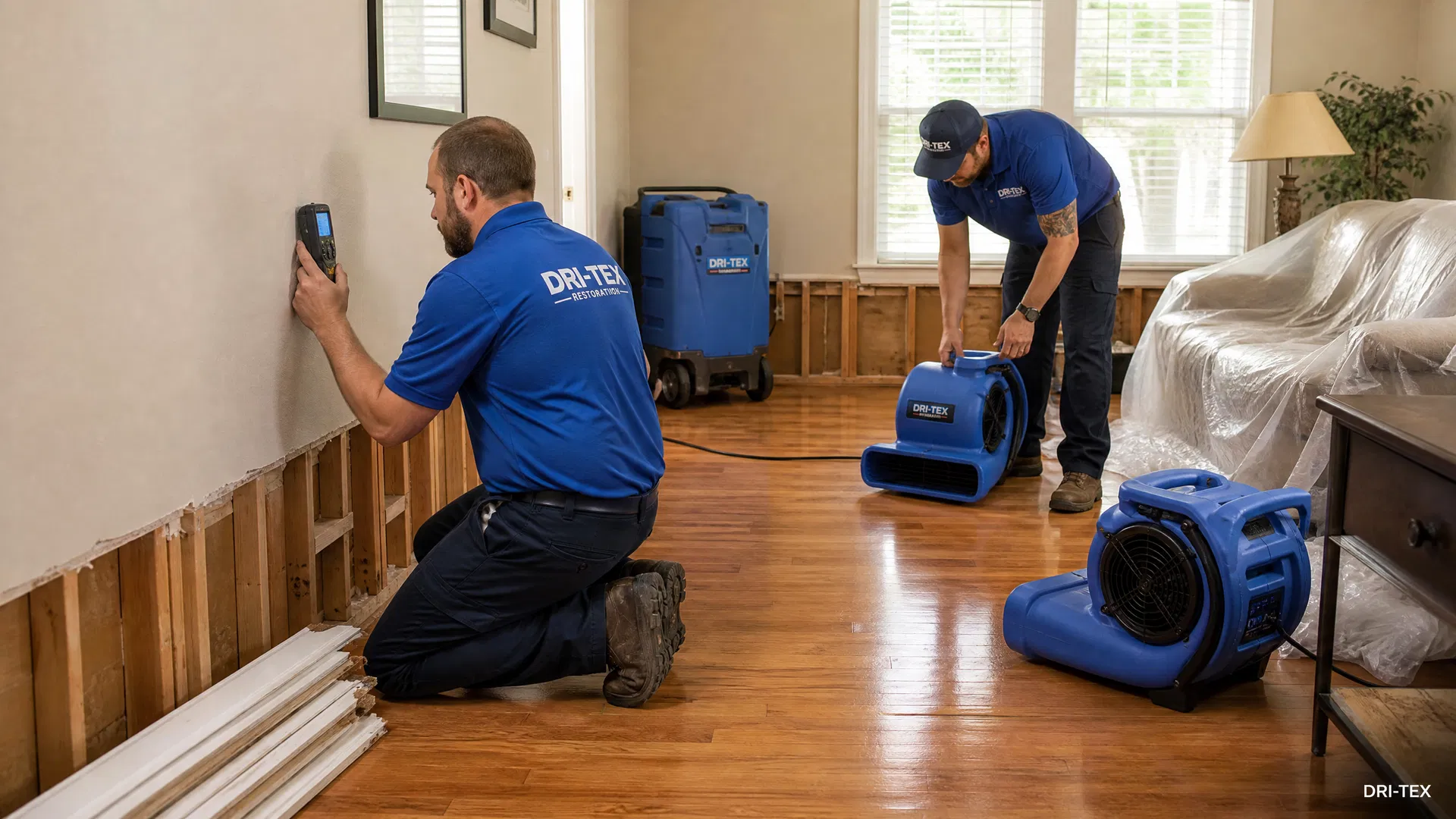
This is the call that determines how the next 30 days of your life look. The longer water sits, the more building materials have to be removed and replaced rather than dried in place. A licensed, IICRC-certified mitigation team can be on site quickly with commercial extraction equipment, air movers, dehumidifiers, and moisture meters that pull water out of materials your eyes cannot see.
What a professional water damage restoration response actually does:
• Performs a full moisture assessment using thermal imaging and meters to find hidden water inside walls, under flooring, and in ceiling cavities
• Sets up containment, extraction, and structural drying using commercial-grade equipment
• Documents everything for your insurance claim (scope, photos, moisture readings, daily logs)
• Coordinates directly with your insurance adjuster so you do not have to translate between trades
• Identifies whether mold remediation, reconstruction, or other follow-up services will be needed — and gets ahead of them
Most established restoration companies in the Conroe and Greater Houston area, including Dri-Tex Restoration, offer 24/7 emergency response. There is no benefit to waiting until business hours.
Step 6: Notify Your Insurance Company
Call your homeowner's insurance carrier as soon as the situation is stable and you have documentation. You do not need to have all the answers yet — you just need to open the claim. Have ready:
• Your policy number
• Date and approximate time you discovered the damage
• A short description of what happened
• The photos and videos you took in Step 3
Most policies cover sudden and accidental water damage (a burst pipe, a failed appliance, a roof breach from a storm). Most do not cover gradual damage from a long-ignored leak, or damage from flooding that comes from outside the home (which generally requires separate flood insurance). Your adjuster will explain what is covered. A good restoration company will work directly with your adjuster, share scope and documentation, and reduce friction throughout the claim.
One important note: you have the legal right to choose your own restoration contractor in Texas. Insurance companies may suggest a preferred vendor, but the choice is yours. Pick the company you trust to do the job right the first time, not the one that promises the lowest number on day one.
Step 7: Watch for Mold and Hidden Water Damage Over the Next Few Weeks
Even after professional drying, keep an eye on the affected areas for the next 30 to 60 days. Warning signs that water damage is not fully resolved include:
• A musty or earthy smell that comes and goes
• Discoloration, bubbling, or peeling paint on walls or ceilings
• Warped or buckling flooring
• New allergy symptoms — coughing, sneezing, headaches — that are worse indoors
• Visible mold growth, even small amounts, in corners, behind furniture, or near baseboards
Any of these signs warrants a call back. Mold remediation is a separate process from water mitigation, and the sooner it is addressed, the smaller the project.
The Most Common Mistakes Homeowners Make After Water Damage
After 20+ years of restoration work in Texas, the same handful of mistakes show up again and again:
• Waiting overnight to "see if it dries on its own." In Conroe humidity, it almost never does, and you have just lost the most important window.
• Ripping out drywall and flooring before the insurance adjuster sees the scope. Documentation has to come first.
• Using only a fan and assuming the job is done. Air movement without dehumidification just pushes moisture into other materials.
• Trusting a quote that comes in dramatically lower than everyone else's. In restoration, low usually means an incomplete scope — and you find out the hard way three months later when mold appears.
• Not asking whether the company is licensed and IICRC-certified. In Texas, mold remediation in particular requires a TDLR license — Dri-Tex Restoration holds TDLR #RC01533 and IICRC #70007514.
When to Call Dri-Tex for Emergency Water Damage Help
If any of the following are true, call us before you do anything else:
• Standing water covers more than a small area, or has spread across more than one room
• Water has reached drywall, baseboards, flooring, or insulation
• The leak is from a category 2 or 3 source (washing machine, dishwasher, sewage, or storm water)
• You smell anything musty, even faintly
• You are not sure what the right next step is
Our team responds 24/7 across Montgomery County, Conroe, The Woodlands, Spring, Willis, Magnolia, and the Greater Houston area. We arrive with the equipment to assess and begin mitigation on the first visit, and we coordinate directly with your insurance adjuster so you can focus on your family instead of paperwork.
The Bigger Picture: It Is Not Just About Drying a Floor
Most people do not call a restoration company because they want water damage repair. They call because something does not feel right in their home, and they want answers they can trust. Our job is not just to remove water — it is to take uncertainty off the table. We identify what is actually happening, explain it in plain language, fix it the right way, and then verify it is resolved with documentation you can stand behind.
When we are done, our clients do not have to guess, worry, or hope. The home is dry, the moisture is gone, the claim is documented, and life goes back to normal.
Discovering water damage in your home is stressful — but the right first call makes the next 30 days dramatically easier. Dri-Tex Restoration provides 24/7 emergency water damage mitigation, mold remediation, and full reconstruction services for homeowners and property managers across Montgomery County and the Greater Houston area.
Call us now at (936) 324-0006 for immediate emergency response, or schedule an inspection to learn more about our water damage restoration services.