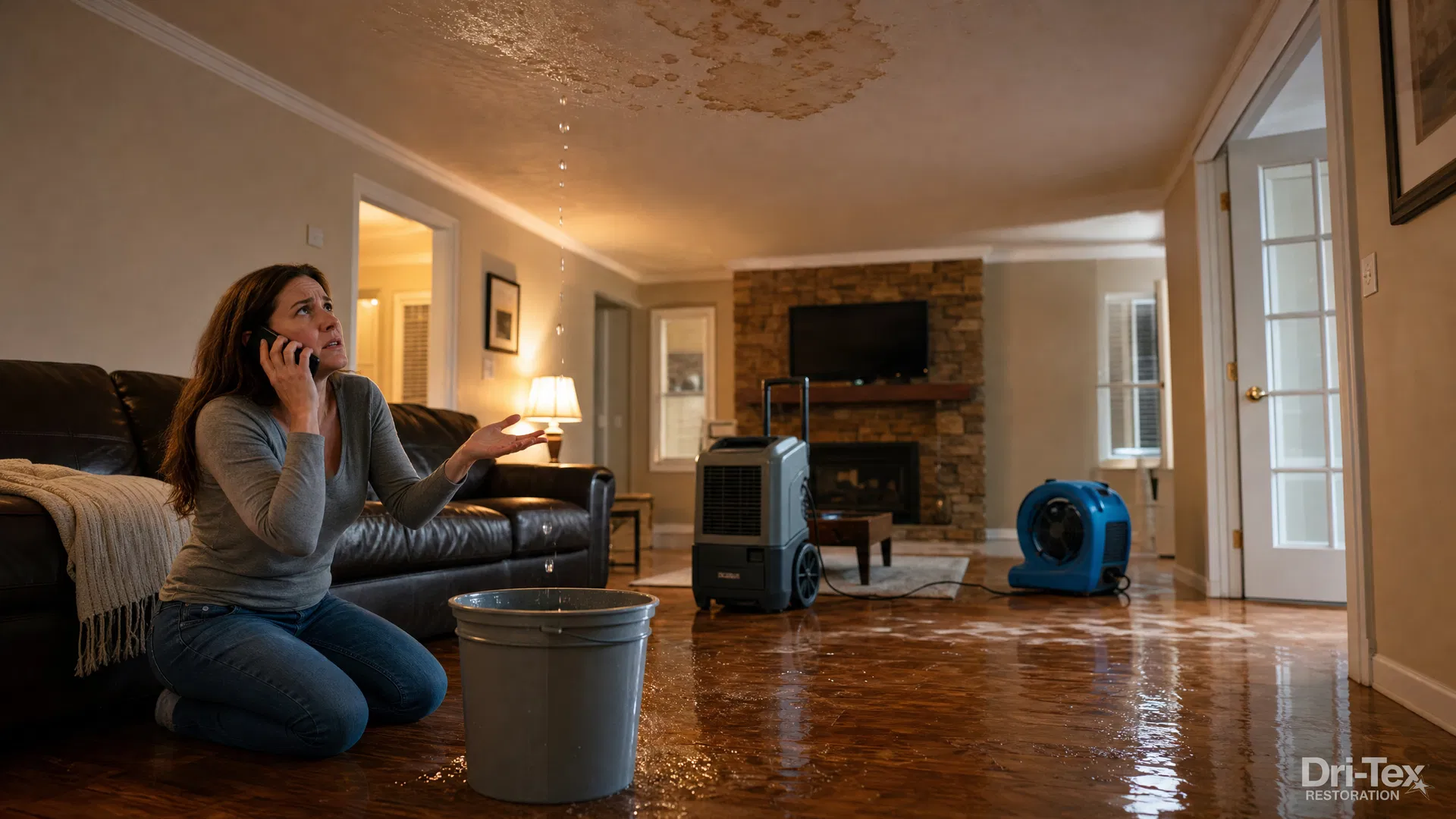
Few questions stress homeowners out faster than this one: "Will my insurance actually pay for this?" After 20+ years of working alongside adjusters, agents, and homeowners across Montgomery County and the Greater Houston area, the team at Dri-Tex Restoration has seen the answer hinge on details that most people never thought to ask about until water was already on their floor.
Water damage insurance is one of the most misunderstood parts of a standard homeowner's policy. Some claims are approved within days. Others are denied flat out. The difference usually comes down to two things: what caused the water, and how quickly the homeowner responded.
This guide breaks down exactly when water damage is covered, when it is not, and what you can do to protect your claim before, during, and after a loss. We are not insurance agents and nothing here is a substitute for reading your specific policy, but after thousands of jobs documented in Xactimate and coordinated directly with adjusters, we know the patterns that decide outcomes.
The Core Rule of Water Damage Insurance Coverage
Standard homeowner's insurance policies in Texas (typically the HO-3 form, the most common policy type) generally cover water damage that is sudden and accidental. They generally do not cover damage that is gradual, preventable, or caused by neglect.
That single distinction — sudden and accidental versus gradual and preventable — is the lens an adjuster uses to evaluate almost every claim. Once you understand that frame, most coverage questions become easier to answer.
Sudden and accidental — usually covered:
• A pipe bursts in your wall overnight
• A washing machine hose suddenly fails and floods the laundry room
• A water heater ruptures without warning
• A toilet supply line breaks while you are at work
• A storm causes a tree to puncture your roof and rain enters the home
Gradual or preventable — usually not covered:
• A slow leak under a sink that has been dripping for months
• Mold from long-term humidity that was never addressed
• Damage from a roof that was already leaking for a year
• Wear-and-tear corrosion of old plumbing
• Damage caused by neglected maintenance
This is where many denied claims come from. The water is real, the damage is real, but the cause is something the policy treats as a maintenance issue rather than an accident.
Common Water Damage Scenarios and How Insurance Typically Treats Them
Here is how the most common situations we see in Conroe, The Woodlands, Spring, Willis, and the Greater Houston area usually break down. Your policy may differ, so always confirm with your agent.
| Scenario | Typical Coverage | Why |
|---|---|---|
| Burst pipe behind a wall | Covered | Sudden and accidental internal failure |
| Pipe burst from a hard freeze (no heat left on) | Often denied | Insurer may consider it preventable negligence |
| Water heater rupture | Covered | Sudden mechanical failure |
| Slow leak under sink (months old) | Usually denied | Considered gradual damage / lack of maintenance |
| Roof breach from a storm | Covered | Sudden weather event |
| Roof leak from years of wear | Usually denied | Considered maintenance |
| Sewer backup into the home | Only with a rider | Standard policies exclude; needs add-on coverage |
| Flood from a storm or rising water | Not covered | Requires separate NFIP or private flood policy |
| Appliance hose failure (washer, dishwasher) | Covered | Sudden mechanical failure |
| Mold from a covered water loss | Often partial | Many Texas policies cap mold at $5,000–$10,000 |
The Biggest Misunderstanding: Flood Damage Is Not the Same as Water Damage
This is the single most painful conversation we have with homeowners. After every major Texas storm, families call expecting their homeowner's policy to cover flooding, and many find out for the first time that flood damage is not water damage in the eyes of an insurer.
Water damage generally means water that originates inside your home, like a burst pipe or appliance failure, or rain entering through a sudden roof breach.
Flood damage generally means water that comes from outside the home and rises onto your property, including overflow from rivers, creeks, hurricane storm surge, flash flooding, or sustained heavy rain causing surface water to enter the home.
Standard homeowner's insurance does not cover flood damage. Period. Flood coverage requires a separate policy, either through the National Flood Insurance Program (NFIP) or a private flood insurer. Given how much of Montgomery County sits in or near flood-prone zones, this is a conversation worth having with your agent before hurricane season, not after.
Three Real Water Damage Insurance Claims (And What They Teach)
These are anonymized examples drawn from actual jobs we have worked in the Conroe area. The dollar figures and outcomes are real.
Case 1: The Approved Claim — Burst Supply Line
A family in The Woodlands left for a long weekend. A toilet supply line failed on the second floor about 12 hours into the trip. By the time a neighbor noticed water coming from under the front door, the entire upstairs hallway, master bedroom, and a section of the first-floor ceiling were saturated.
Outcome: Fully covered. Total claim was approximately $42,000 across mitigation, demolition, and reconstruction. The carrier paid because the failure was sudden and accidental, the homeowner reported it within hours of discovery, and we documented every wet material with moisture readings and photos before any demo started.
Why it worked: Speed of response, complete documentation, and a clear sudden-and-accidental cause.
Case 2: The Denied Claim — Slow Leak Under a Vanity
A homeowner in Conroe noticed warped flooring in a guest bathroom. When we opened the vanity, the plumbing connection had been dripping slowly for what the inspector estimated was at least six months. Mold had spread behind the wall.
Outcome: Denied. Total out-of-pocket cost to the homeowner: approximately $18,000.
Why it failed: The carrier's adjuster classified it as gradual damage and lack of maintenance, both standard exclusions. The age of the leak was visible in the staining patterns on the subfloor.
The lesson: Inspect under sinks and behind appliances quarterly. A flashlight check that takes five minutes can prevent a five-figure denial.
Case 3: The Partial Claim — Storm + Pre-Existing Wear
A storm tore shingles off a roof in Spring, Texas, and rain poured into the attic and master bedroom. The homeowner filed promptly. The adjuster determined that part of the roof was already in poor condition before the storm.
Outcome: Partial approval. The carrier paid for the interior water damage (sudden, storm-caused) but only a portion of the roof replacement, citing pre-existing wear.
The lesson: Roof maintenance affects more than the roof. Annual inspections protect you on multiple coverage fronts.
Things That Can Get Your Water Damage Insurance Claim Denied
After hundreds of claims worked alongside adjusters, these are the issues that come up most often when a claim gets reduced or denied:
• Waiting too long to report. Most policies require prompt notification. Waiting days or weeks looks like neglect.
• No documentation of the original scene. If you cleaned everything before taking photos, the adjuster has nothing to verify.
• Doing demolition before the adjuster sees the loss. Once drywall is in a dumpster, it cannot be measured.
• Using an unlicensed or uncertified contractor. In Texas, mold remediation requires a TDLR license. Carriers may push back on work performed without proper credentials.
• Existing exclusions you did not know about. Sewer backup, mold, and slab leaks are common exclusions that often need an endorsement.
• Failure to mitigate. Policies require you to take reasonable steps to prevent further damage. Letting water sit can void coverage on the secondary damage.
• Inconsistent stories. The cause you describe to the adjuster needs to match the physical evidence on site.
How to Protect Your Water Damage Insurance Claim From Day One
If you take only one thing from this article, take this section. These are the steps that consistently separate smooth claims from contested ones.
1. Document everything before you touch anything
Photos and video of every affected room, the source of the water, and damaged belongings. Wide shots and close-ups. Time-stamped on your phone. This is the single highest-leverage thing you can do in the first hour after discovering water damage.
2. Notify your insurer promptly
Same day if possible. You do not need to have all the answers. You just need to open the claim. Get your claim number written down.
3. Take reasonable steps to mitigate
Shut off the water source. Move belongings out of wet areas. Place towels or buckets where you can. Most policies require this, and it is also how you keep a $5,000 problem from becoming a $30,000 problem.
4. Hire a licensed, IICRC-certified restoration company
In Texas, restoration companies handling mold remediation must hold a TDLR license. Dri-Tex Restoration holds TDLR #RC01533 and IICRC #70007514. A properly credentialed company documents the loss using the same software adjusters use (Xactimate), which dramatically reduces friction during the claim.
5. Know your right to choose your contractor
In Texas, you have the right to choose your own restoration contractor. Insurance carriers often suggest a preferred vendor, sometimes called a Third Party Administrator (TPA) program, but the choice is yours. Pick the company you trust to do the job right the first time.
6. Keep a paper trail
Save every receipt for emergency mitigation, hotel stays if you are displaced, replacement of personal items, and any communication with the carrier. Texas policies typically include Additional Living Expense (ALE) coverage for situations where the home is not livable during repairs.
Insurance Endorsements Worth Asking Your Agent About
If you are still in a position to update your policy (and most homeowners are), these endorsements are worth a conversation:
• Sewer and drain backup coverage. A standard policy excludes water that backs up through drains. Endorsements typically run $40–$100 a year and can save tens of thousands in a backup event.
• Service line coverage. Covers the water and sewer lines running from the street to your home, which standard policies often exclude.
• Increased mold limit. Many Texas policies cap mold remediation at $5,000–$10,000. Higher limits are usually available.
• Flood insurance (NFIP or private). If you are anywhere near a creek, bayou, or flood plain, this is essential. Conroe and Montgomery County have plenty of both.
• Higher dwelling coverage. Construction costs have risen significantly. A policy written five years ago may not actually cover the cost to rebuild today.
How Dri-Tex Restoration Helps With Water Damage Insurance Claims
We are not your insurance agent and we do not negotiate your policy. What we do is make sure the work is documented, scoped, and communicated in a way that gives the claim the best possible chance of being paid in full.
On every water damage job we handle, we:
• Arrive 24/7 with commercial extraction and drying equipment
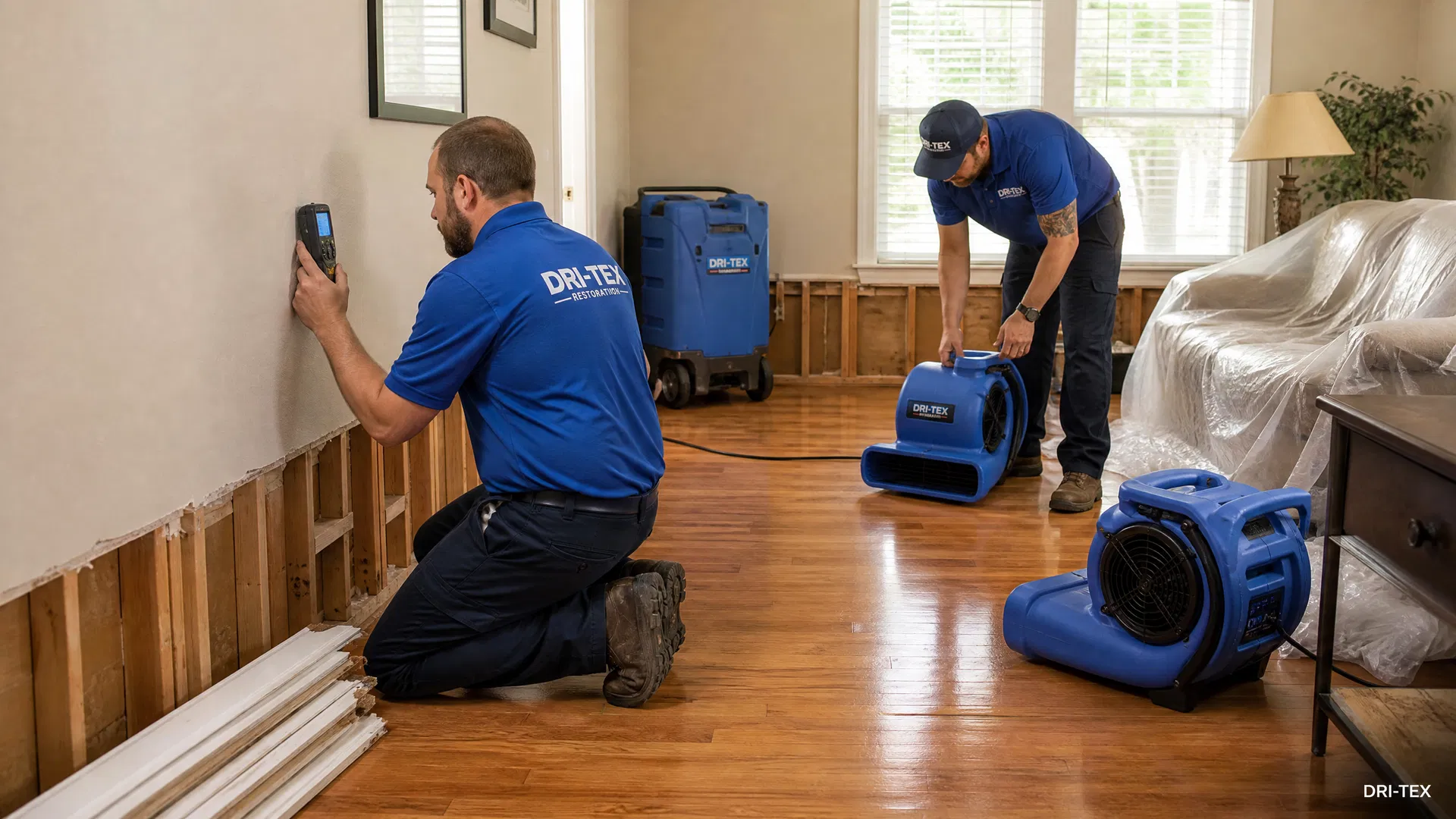
• Document the loss with thermal imaging, moisture readings, and dated photos before any demolition
• Build the scope in Xactimate, the same estimating software used by most insurance carriers
• Communicate directly with your adjuster so you do not have to translate between trades and insurance language
• Provide daily drying logs and final clearance documentation
• Hold IICRC and TDLR licensing, which carriers and adjusters recognize and trust
Homeowners often tell us the most valuable thing we provide is not the drying equipment — it is the certainty that the paperwork is right and the work is defensible. That is what makes a water damage insurance claim move smoothly.
Need Help With Water Damage Insurance Claims in Conroe TX?
Whether you are dealing with a fresh leak or trying to figure out if a problem is covered, the team at Dri-Tex Restoration can help you understand the scope, document the damage properly, and coordinate directly with your adjuster. We work on the restoration side — you stay in control of your water damage insurance claim, and we make sure the documentation supports it.
Call us anytime at (936) 324-0006 for 24/7 emergency response, or schedule an inspection. We serve Conroe, The Woodlands, Spring, Willis, Magnolia, Montgomery, and the Greater Houston area.
Licensed, insured, and IICRC-certified. IICRC #70007514 | TDLR #RC01533
Disclaimer: This article is for general informational purposes and does not constitute insurance advice. Coverage varies by policy, carrier, and circumstances. Always review your specific policy and consult with your insurance agent for guidance on your coverage.