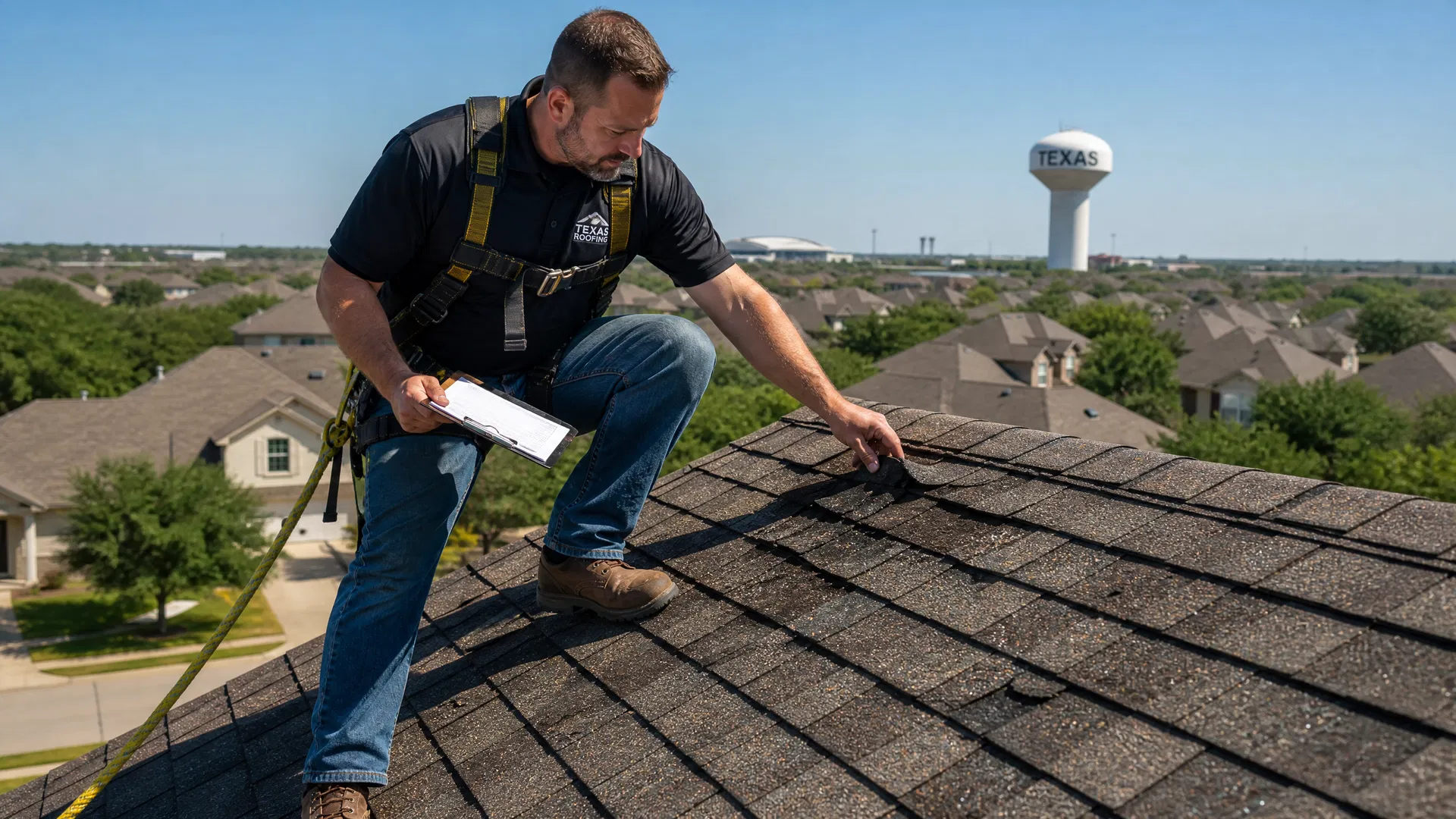
Most homeowners think about their roof exactly twice: when they buy the house, and when it starts leaking. Everything in between gets ignored — which is unfortunate, because the roof is the single most important defense the home has against Texas weather, and the signs that it is failing usually show up months or years before the leak does.
Across Conroe, The Woodlands, Spring, and the Greater Houston area, the Dri-Tex Restoration team responds to a steady stream of water damage calls that started as roof problems homeowners did not catch in time. With over two decades of experience handling both roofing and the cascade of damage that follows roof failures, we have seen the patterns clearly. Most roofs telegraph their decline. You just have to know where to look.
This guide is a homeowner-friendly roof inspection walkthrough. It covers what to check from the ground, what to check inside the attic, what to check after a storm, and how to know whether you are looking at a repair situation or a full replacement situation. Doing this twice a year takes about 30 minutes — and is one of the highest-return home maintenance habits a Texas homeowner can have.
When to Perform a Roof Inspection on Your Home
In Texas, the recommended cadence is at least twice a year — once in early spring before storm season ramps up, and once in late fall after hurricane season ends. Add an extra inspection any time:
• A significant storm passes through your area (hail, high winds, tornado activity)
• You notice any interior stains, drips, or musty odors
• You are approaching the manufacturer’s expected lifespan for your roof material
• You see neighbors getting roof replacements after a weather event — if their roof was affected, yours likely was too
• You are preparing to sell or buy a home
A homeowner roof inspection is not a substitute for a professional inspection, but it is what tells you when to call one.
The Lifespan Question: When Does a Roof Need to Be Replaced by Age?
Age is the most reliable indicator of whether a roof is approaching replacement. Even a well-maintained roof has a finite life, and Texas climate accelerates the timeline.
| Roof Material | Manufacturer Lifespan | Typical Lifespan in Texas Climate |
|---|---|---|
| Three-tab asphalt shingles | 20-25 years | 12-18 years |
| Architectural (dimensional) asphalt | 30-50 years | 18-25 years |
| Premium / impact-rated (Class 4) | 40-50 years | 22-30 years |
| Metal roofing | 40-70 years | 35-50 years |
| Tile (clay or concrete) | 50+ years | 40-60 years |
Texas climate cuts roof life by 25 to 40 percent compared to manufacturer ratings. Sustained UV, summer heat, humidity, hail exposure, and hurricane-force winds all accelerate shingle wear. A 30-year shingle in California may last 30 years. The same shingle in Conroe is more likely to last 18 to 22.
Practical rule of thumb: If your roof is past 75 percent of its expected Texas lifespan, schedule a professional roof inspection regardless of how it looks from the ground. Hidden wear is often invisible until it fails.
The Ground-Level Roof Inspection: What to Check From the Yard
Most of what you need to see is visible from the ground with a good pair of binoculars or a phone camera at maximum zoom. Never climb onto your own roof unless you have proper safety equipment and experience — falls are the leading cause of injury in this industry, and the view from the ground catches 80 percent of the warning signs.
Walk the perimeter of your home and look for the following:
1. Missing, Cracked, or Curled Shingles
Healthy shingles lie flat against the roof in uniform color and shape. Curling shingles (edges lifting up like potato chips) signal heat damage or end-of-life. Cracking signals brittleness. Missing shingles signal recent wind damage. Any of these warrants closer attention.
2. Granule Loss and Bald Spots
Asphalt shingles have small protective granules embedded in their surface. As they age, those granules wear off, leaving smooth bald spots that look slightly darker. Check your gutters too — heavy granule accumulation in the gutters is a strong indicator that the shingles are shedding rapidly.
3. Sagging or Uneven Roof Lines
Sight along the ridge line and edges of the roof. A healthy roof has straight, uniform lines. Sagging, dipping, or wave patterns suggest structural problems — water damage to the decking, framing issues, or settling that has compromised the support structure.
4. Damaged or Missing Flashing
Flashing is the metal sealant around chimneys, vents, skylights, and where the roof meets walls. Look for rust, separation, lifted edges, or any visible gaps. Flashing failures are one of the most common sources of roof leaks.
5. Moss, Algae, or Heavy Dark Streaks
Black streaks on a roof are usually caused by algae growth (Gloeocapsa magma) — cosmetic and rarely structural, but a sign of moisture retention. Actual moss growth (raised green or gray patches) is more serious. Moss holds moisture against the shingle surface and can lift shingle edges over time.
6. Visible Damage to Ridge Cap, Drip Edge, or Gutters
The ridge cap is the line of shingles along the very top of the roof. The drip edge is the metal strip along the bottom edge. Both are heavy-wear areas. Damage here is often the earliest sign of broader roof deterioration.
The Attic Roof Inspection: What to Check From Inside
The attic shows you what is happening on the underside of your roof — which is often where problems appear long before they are visible on the exterior. Bring a strong flashlight, wear long sleeves, and inspect on a dry day during daylight hours.
1. Daylight Showing Through the Roof Decking
Turn off attic lights and look up. Any spot of daylight visible through the decking is a hole — small or large — that water can enter through. This is one of the clearest signs that roof integrity is compromised.
2. Water Stains on Rafters, Decking, or Insulation
Dark staining, white efflorescence (mineral residue), or rust around nail heads all indicate moisture has been entering. Some stains are old and dry; others indicate active leaking. Note the location of any stain — it will help a professional roofer trace the source.
3. Damp or Saturated Insulation
Healthy attic insulation is fluffy, light, and dry. Compressed, matted, or stained insulation often signals moisture intrusion from above. Saturated insulation also loses its R-value, which raises cooling costs.
4. Mold or Musty Odors
A musty smell in the attic almost always indicates active or recent moisture intrusion. Visible mold growth on rafters or decking is a sign that water has been present long enough for biological growth to begin — typically within 24 to 48 hours of saturation. If you find mold, do not disturb it. Photograph it and call a TDLR-licensed remediation contractor.
5. Sagging Decking Between Rafters
Look at the decking from below. It should be flat between the rafters. Sagging or warping indicates the decking has been wet, has lost structural integrity, and will likely need to be replaced as part of any roof project.
6. Inadequate Ventilation
A properly ventilated attic should feel close to ambient outdoor temperature, not dramatically hotter. Excess heat shortens shingle life from below. While you are up there, confirm soffit vents and ridge vents are not blocked.
Roof Inspection After a Storm: The Damage You Cannot See From the Ground
After any significant storm in the Conroe and Greater Houston area — especially hail, high winds, or hurricane-force gusts — additional damage often hides in places a ground-level inspection cannot see. This is when a professional storm damage inspection is most valuable.
Storm-specific damage to look for:
• Hail bruising: Small circular indentations where granules have been knocked loose. Often invisible from the ground but visible on the roof surface. Hail damage compromises the shingle’s water resistance but may not leak immediately — it shows up months later.
• Wind-lifted shingles: Shingles that look intact but have been lifted enough to break their seal. Water can now enter underneath the next time it rains.
• Debris impact damage: Tree branches, lawn furniture, or storm debris hitting the roof can crack shingles or damage flashing.
• Displaced ridge cap or hip shingles: The most exposed sections of the roof often suffer first.
Important: If a storm event was significant enough that neighbors are getting roof inspections, get yours done. Insurance carriers in Texas have strict claim windows (typically 1 year from the date of loss). Waiting too long can void coverage even when the damage was real.
Repair vs Replacement: How to Tell the Difference
This is the question that prompts most homeowner roof inspections. The honest answer depends on the answers to four specific questions:
1. Is the damage localized or systemic?
A few missing shingles in one area after a wind event is repairable. Curling, granule loss, and brittleness across the entire roof is systemic — even if no leak exists yet, the roof is at end of life.
2. How old is the roof?
A 6-year-old roof with a small damaged area is almost always worth repairing. An 18-year-old roof with the same damage is usually worth replacing — you will spend the repair cost only to need a replacement within a few years anyway. For more details, see our guide on roof replacement cost ranges.
3. Has the decking been compromised?
If the inspection reveals soft, stained, or sagging decking, you are dealing with more than a surface problem. Decking issues almost always require partial or full reconstruction.
4. Is there active or recent moisture intrusion?
If water has been entering the home, the cost of doing nothing increases every week. Water damage mitigation, mold growth, and insulation saturation become their own projects very quickly.
General rule: Repairs make sense for younger, isolated, surface-only damage. Replacement makes sense for older roofs, widespread damage, decking issues, or anything causing interior moisture.
Two Real Roof Inspections That Made the Difference
Case 1: The Inspection That Caught the Problem in Time
A homeowner in The Woodlands did a routine ground-level roof inspection in April after a hailstorm passed through earlier in the month. From the yard, the roof looked fine. But she noticed slightly heavier granule accumulation in the gutters than usual and scheduled a professional roof inspection.
What the inspection found: Approximately 40 hail bruises spread across the roof surface, invisible from the ground. The shingles were compromised but not yet leaking.
Outcome: She filed an insurance claim within the carrier’s window. The carrier approved a full replacement at $19,800 — she paid only her wind/hail deductible of $3,400. No interior water damage occurred. Total cost of catching it early: minimal.
Case 2: The Inspection That Was Skipped
A homeowner in Conroe noticed slightly heavier than usual granules in his gutter cleanout, plus a small brown stain on the ceiling of his upstairs guest bedroom. He decided to wait and see if it got worse.
What happened: Over the next eight months, the small stain spread, the heat in the attic intensified due to compromised ventilation, and shingle deterioration accelerated. By the time we were called for water damage, two ceiling areas had collapsed, mold had spread across approximately 35 square feet of attic decking, and the roof was beyond repair.
Outcome: Total project: roof replacement at $21,400, water mitigation at $4,800, mold remediation at $3,600, and reconstruction of the affected ceilings at $5,200. Total: $35,000. The insurance carrier covered part but disputed timing because the homeowner could not document when the damage started. He paid roughly $11,000 out of pocket above his deductible.
Lesson: The 30-minute roof inspection he did not do in April cost him the equivalent of a small luxury car eight months later. The roof was going to need replacement either way — what he paid for was the cascade.
When to Stop Inspecting and Call a Professional
Self-inspection is valuable, but there are situations where the next step is calling a professional immediately. Schedule a professional roof inspection if you see any of the following:
• Daylight visible through the attic decking
• Active water staining or drips in any room
• Sagging or wave patterns in the roof line
• Significant granule loss with visible bald spots
• Visible mold or strong musty odors in the attic
• Multiple missing or curled shingles across the roof
• Damaged flashing at any penetration
• Recent significant storm event in your area
• A roof at or past 75 percent of its Texas lifespan
• Heavier than usual granules in the gutters
A professional roof inspection by a credentialed contractor takes 30 to 60 minutes and is often free. The cost of not doing one when you need one can be tens of thousands of dollars. Learn how to choose a qualified roofer and questions to ask a roofing contractor before scheduling.
The Bigger Picture: Why a Regular Roof Inspection Is the Cheapest Insurance You Will Ever Buy
Most homeowners think of a roof as a thing that lasts until it leaks. Industry data tells a different story: the roof is a system that telegraphs its decline for years before it fails catastrophically. Catching the decline at the right point is the difference between a planned $20,000 replacement and an unplanned $35,000 cascade.
Twice a year, 30 minutes each, for as long as you own the home. That is the entire commitment. Then call a professional when something looks off. That is the entire system.
It is one of the most boring and one of the most valuable homeowner habits there is.
Schedule a Professional Roof Inspection in Conroe TX
If your self-inspection turned up anything concerning, or you simply want a credentialed professional to confirm the condition of your roof, the team at Dri-Tex Restoration provides thorough, no-pressure roof inspection services across Conroe, The Woodlands, Spring, Willis, Magnolia, Montgomery, and the Greater Houston area. We document everything in writing, photograph any issues, and explain your options clearly — whether the answer is a small repair, a partial replacement, or a full new roof.
As a full-service restoration company, we also handle water damage, mold remediation, and reconstruction in-house — so if the inspection reveals that your roof has already started causing interior damage, you have one accountable team for the entire response.
Call us anytime at (936) 324-0006 to schedule a free roof inspection, or visit www.dri-tex.com to book online.