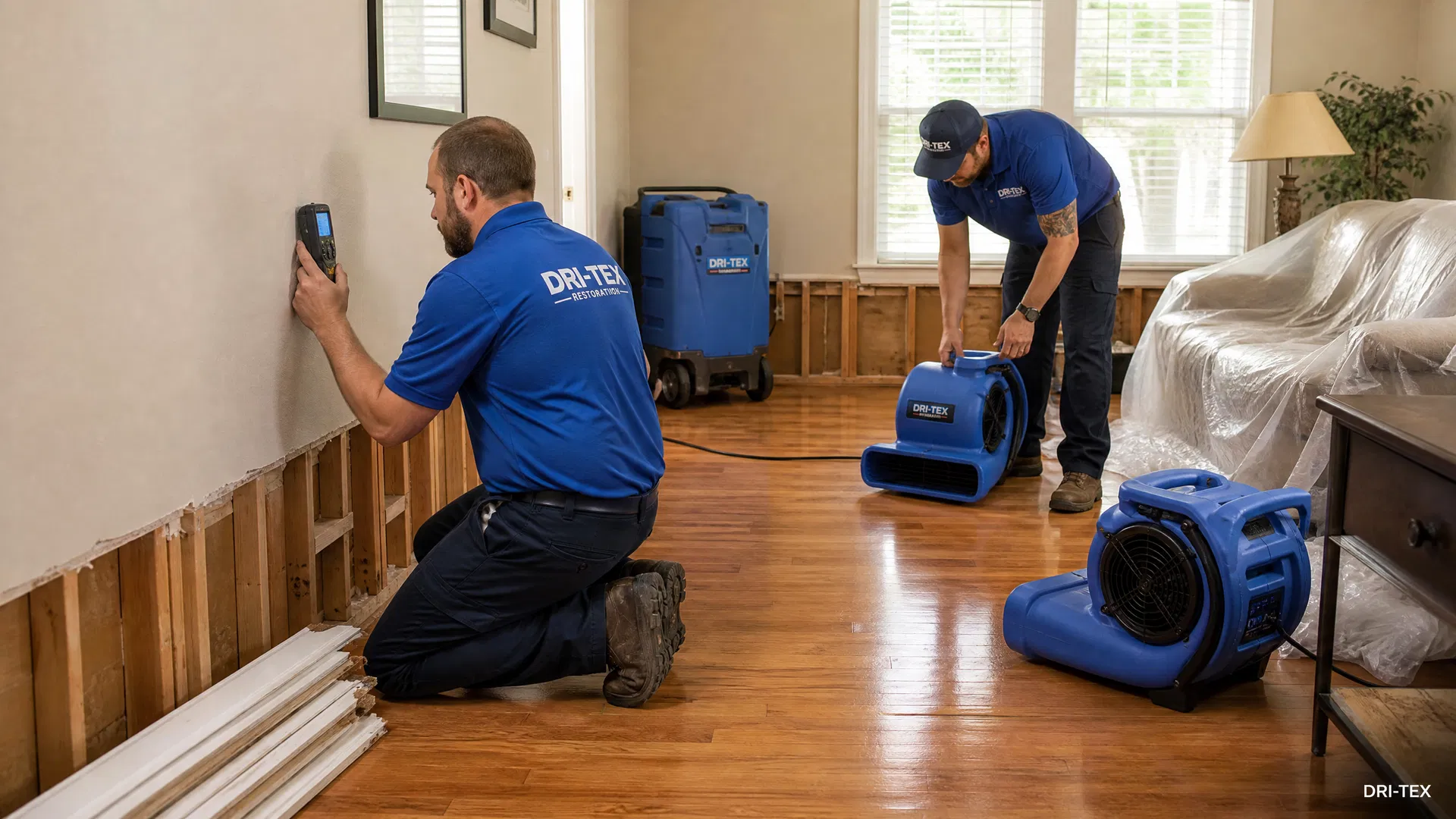
The phone call usually happens within an hour of filing a claim. A homeowner reports water damage to their insurance carrier, and before they have even finished mopping up the kitchen, an adjuster or claims representative is on the line with a name and a number.
"We have a preferred vendor in your area. They can be there within two hours. Would you like us to dispatch them?"
It feels efficient. It feels like the insurance company is handling things. And for a homeowner in the middle of a crisis, saying yes is the easiest answer.
But that yes carries weight most people do not realize at the time. After more than 20 years of combined industry experience responding to water losses across Montgomery County, our team at Dri-Tex Restoration has seen what happens on both sides of this decision. Homeowners are not always told the full picture before they agree.
This post answers the question directly: no, you do not have to use the water damage restoration company your insurance recommends. Here is what you actually need to know before you make that call.
The Short Answer: You Choose Your Restoration Company
Under your homeowner’s insurance policy, you are the policyholder. You have the right to select the contractor or restoration company that performs work on your property. Your insurance carrier can recommend vendors. They can offer you a list. They cannot require you to use a specific company.
This is true in Texas and in nearly every state. The Texas Department of Insurance has been clear on this point for years: the homeowner selects the contractor.
If anyone tells you otherwise — whether it is an adjuster, a claims representative, or a vendor calling on behalf of the carrier — that is incorrect. Push back, ask for the statement in writing, and then make your own choice.
Learn more about our Water Damage Restoration process.
What a "Preferred Vendor" Actually Is
Insurance carriers maintain networks of preferred vendors, sometimes called TPA programs (third-party administrator programs) or direct repair networks. These companies have signed agreements with the carrier that govern how they price work, document jobs, and handle disputes.
Preferred vendor agreements typically include:
• Pre-negotiated pricing that is often lower than market rate
• Required use of the carrier’s preferred software and scope formats
• Performance metrics tied to claim cycle time
• Service level agreements that prioritize the carrier’s interests
• Volume commitments that incentivize the vendor to keep the carrier happy
There is nothing illegal about these arrangements. Many preferred vendors do good work. But it is important to understand who the vendor is contractually accountable to — and in a preferred vendor relationship, the answer is the insurance carrier, not the homeowner.
That distinction matters when scope disputes happen. And in water damage restoration, scope disputes happen often.
Where the Conflict of Interest Shows Up
Most homeowners assume that the restoration company is on their side. In a preferred vendor relationship, the alignment is more complicated.
The carrier wants the claim closed quickly and inexpensively. The homeowner wants the property restored fully and correctly. Usually these goals overlap. Sometimes they do not.
Common areas where conflict appears:
• Drying decisions — Should affected materials be saved and dried in place, or removed and replaced? Replacement often takes longer and costs more, but is sometimes the right call.
• Mold prevention — Should antimicrobial treatments be applied to materials that show no visible mold but were saturated? Best practice often says yes. Lower-cost scopes often skip it.
• Hidden damage — When moisture readings suggest water traveled further than the visible damage shows, who decides how aggressively to investigate?
• Reconstruction quality — Should subfloor be replaced or sanded and sealed? Should baseboards be replaced or salvaged?
In each of these decisions, an independent restoration company answers to the homeowner. A preferred vendor often answers to the carrier first.
A Real Example From the Field
A homeowner in The Woodlands called us last year as a second opinion. She had already engaged her carrier’s preferred vendor after a refrigerator line failure flooded her kitchen and the adjacent dining room.
The preferred vendor’s scope called for spot-drying the affected area, removing four feet of drywall, and salvaging the original hardwood floor. Drying was scheduled for three days.
On day two, the homeowner noticed the floor was cupping more, not less. The vendor told her the floor would "relax back" once it was fully dry. She was uncertain, so she called us for a second opinion.
When our technician arrived with thermal imaging, the readings told a different story. Moisture had traveled under the hardwood into the adjacent living room and partway down a hallway. The preferred vendor’s scope did not cover any of that area. The cupping was not going to relax back — the floor had absorbed too much water for too long.
We documented the additional moisture, sent the readings to her adjuster, and the scope was rewritten. The carrier approved the expanded work. The original vendor was replaced at the homeowner’s request.
This is not an indictment of preferred vendors generally. It is a reminder that the homeowner has the right to a second opinion, and that exercising that right is sometimes the difference between a proper restoration and a problem that resurfaces in six months.
When water damage is not caught early, mold remediation often becomes necessary.
What Your Policy Actually Says
Pull out your homeowner’s insurance policy and look for language around contractor selection. Most policies include some version of the following:
• The insured (you) has a duty to mitigate further damage
• The insured may select the contractor of their choice
• The carrier has the right to review and approve the scope of work
• The carrier may dispute charges that are deemed unreasonable
That last point is where most disputes arise — but the right to choose the contractor is not in question. The carrier’s role is to review the scope, not to dictate who performs it.
If your adjuster pressures you to use a specific vendor, ask them to send the request in writing along with the policy language that requires it. In nearly every case, you will not receive that document, because it does not exist.
When a Preferred Vendor Might Be the Right Choice
To be fair, there are situations where using your carrier’s preferred vendor makes sense:
• The damage is straightforward and the scope is unlikely to be contested
• You do not have a local restoration company you trust
• You want a single point of contact between the vendor and the carrier
• You are managing the claim from out of state or while traveling
• The preferred vendor in your area has strong independent reviews
The point is not that preferred vendors are bad. The point is that you have a choice, and that choice should be informed.
How to Choose Your Own Water Damage Restoration Company
If you decide to select your own company, here is what to confirm before signing anything:
• IICRC certification in water damage restoration (WRT) and applied structural drying (ASD)
• Local presence with crews that can dispatch the same day
• Direct insurance billing experience and fluency in Xactimate
• Written mitigation scope provided before work begins
• 24/7 emergency response with a real person answering, not a call center
• Texas licensing for any mold-related work (TDLR)
• Independent reviews on Google and other third-party platforms
A legitimate water damage restoration company will provide all of this without hesitation. If a company resists giving you documentation up front, that is the signal to keep looking.
Schedule a moisture inspection with our team.
What to Say to Your Insurance Carrier
When the carrier offers their preferred vendor, the language to use is simple and polite:
"Thank you. I appreciate the recommendation, but I have a restoration company I would like to use. Can you confirm where to send their documentation for the claim?"
That sentence ends the conversation. The carrier will provide claim information, and your chosen company will handle the rest. You do not need to justify the decision, apologize for it, or negotiate around it.
If pressure continues after that point, you have the right to escalate to the carrier’s supervisor or file a complaint with the Texas Department of Insurance.
The Bottom Line
Your insurance carrier exists to fund the work that gets your home back to its pre-loss condition. The carrier is not required to choose the contractor for you, and you are not required to use the contractor they suggest. Those are two separate things, and treating them as one is what costs homeowners money and quality.
A trusted local water damage restoration company should be able to handle the claim documentation, the mitigation work, and the reconstruction phase while keeping your interests — not the carrier’s — at the center of every decision.
Schedule a Water Damage Inspection in Montgomery County
If you have water damage at your home and your insurance carrier has already recommended a vendor, take a moment before you agree. A no-obligation moisture inspection from an independent water damage restoration company gives you a second opinion before the scope is locked in.
Dri-Tex Restoration is a licensed, IICRC-certified restoration company serving Conroe, Montgomery, Willis, The Woodlands, Spring, and the surrounding Greater Houston area. We work directly with every major insurance carrier, document every step of the claim, and answer to the homeowner — not the carrier.
Call (936) 324-0006 or visit our contact page to schedule an inspection.