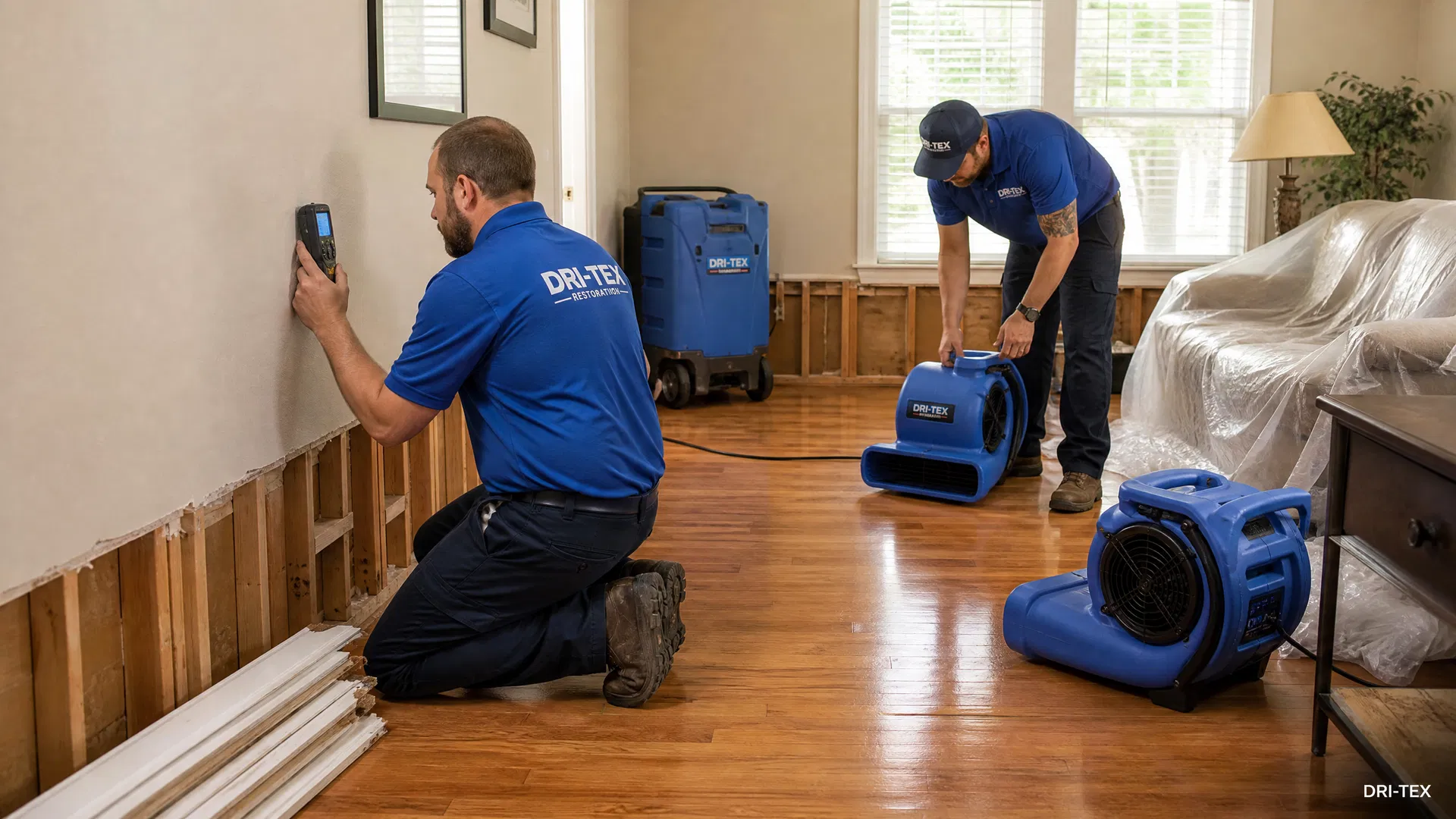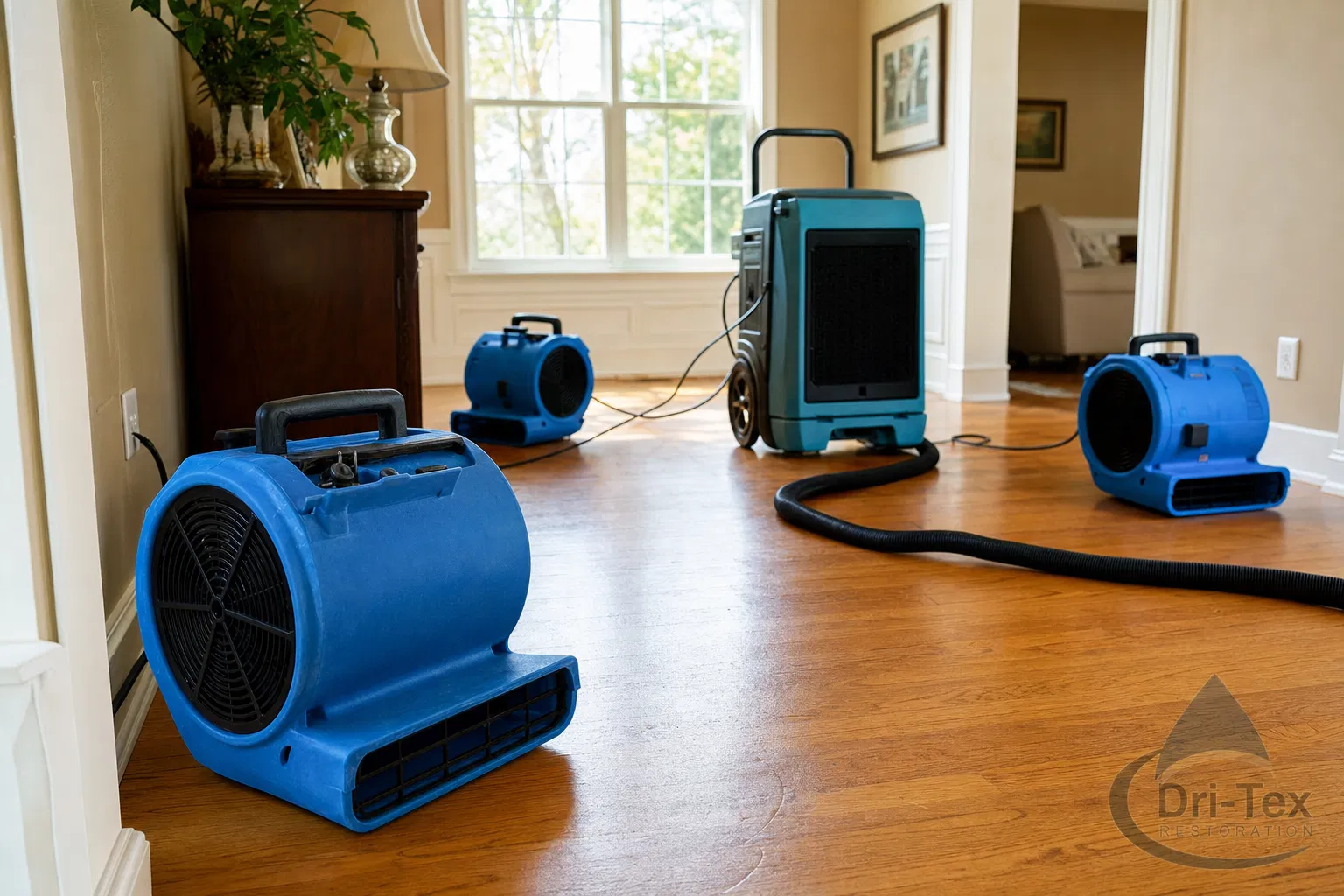
It is one of the first questions every homeowner asks after a water loss. The equipment is set up, the air movers are running, the dehumidifier is humming in the corner, and the homeowner stands in the doorway thinking the same thing:
"How long is this going to take?"
The honest answer is the one most restoration companies do not give clearly enough: it depends. Not in a vague way — in a specific, measurable way that comes down to a handful of variables that any qualified technician can walk you through.
After more than 20 years of combined industry experience responding to water losses across Montgomery County, our team at Dri-Tex Restoration has dried everything from single-room appliance leaks to multi-room Category 3 losses in older homes. The timelines vary, but the principles do not. This post explains how long water damage actually takes to dry, what affects that timeline, and how to know when drying is truly complete.
The Short Answer: Three to Five Days for Most Residential Losses
For a typical Category 1 (clean water) residential loss with proper equipment and an experienced crew, complete structural drying takes three to five days. That is the working baseline.
That number assumes:
• The water source was shut off within the first few hours
• A restoration company arrived same-day with proper equipment
• Affected materials were either removed or properly exposed for drying
• The home was sealed (windows closed, HVAC managed) to allow the dehumidifiers to do their job
• Daily monitoring confirmed moisture levels were trending down
Strip any of those conditions away and the timeline extends. Add unusual variables — Category 2 or 3 water, dense materials like hardwood or plaster, hidden saturation — and the timeline can extend significantly.
Learn more about our Water Damage Restoration services
The Five Variables That Actually Determine Drying Time
Every water damage job is shaped by the same five factors. A qualified restoration company evaluates all of them during the initial assessment.
1. The Category of Water
Water category drives both the drying timeline and what materials can be saved.
• Category 1 (clean water) — supply line breaks, appliance leaks, rain through a roof. Most materials can be dried in place. Typical timeline: three to five days.
• Category 2 (gray water) — washing machine overflows, dishwasher discharge, aquarium failures. Some porous materials must be removed. Timeline: four to seven days due to additional demolition and antimicrobial treatment.
• Category 3 (black water) — sewage backups, flood water from outside the structure, prolonged stagnant water that has degraded. Most porous materials must be removed entirely. Timeline: five to ten days or longer, with significant reconstruction following.
2. The Class of Loss
The IICRC defines four classes of water loss based on how much material is saturated.
• Class 1 — small area, minimal absorbent materials. Fastest to dry.
• Class 2 — entire room affected, with water absorbed into walls up to about 24 inches.
• Class 3 — water came from above, saturating ceilings, walls, insulation, and floors. Slowest of the standard classes.
• Class 4 — specialty drying for dense materials like hardwood, concrete, plaster, or stone. Often extends the timeline beyond the standard window.
3. The Materials Affected
Different materials hold moisture differently and release it at different rates.
• Carpet and pad — fastest to dry once extracted, often within 24 to 48 hours
• Drywall — typically three to five days if not removed
• Wood framing — three to seven days depending on density and saturation depth
• Hardwood flooring — often the slowest material, sometimes requiring specialized mat-based drying systems for seven to ten days or longer
• Concrete and masonry — can hold moisture for weeks if saturated through
4. The Environment
Ambient conditions inside the home matter more than most homeowners realize.
• Temperature — warm air holds more moisture, which improves dehumidifier efficiency. Most drying happens between 70 and 85 degrees.
• Humidity — Texas humidity works against the drying process when outside air enters the structure. Sealing the affected area is essential.
• Air movement — directional airflow across wet surfaces speeds evaporation. Too few air movers extends the timeline. Too many in the wrong placement creates dead zones.
• HVAC status — running the home’s air conditioning during drying often helps. Some scenarios require it to be shut off entirely.
5. The Equipment and Crew
This is the variable homeowners control by choosing the right restoration company. Proper psychrometric calculation determines how many air movers and how much dehumidification capacity a given loss requires. IICRC standards provide specific formulas — typically one air mover per ten to sixteen linear feet of wet wall, with dehumidification scaled to the cubic footage and grain depression needed.
Undertrained crews guess. Trained crews calculate. The difference shows up in the timeline.
A Real Example From the Field
A homeowner in Montgomery called us after a slow leak under a kitchen sink had been running for an estimated two to three days before discovery. The cabinets, the subfloor under the cabinets, and a section of the adjacent dining room hardwood were all affected.
Most homeowners hear “two-day leak” and assume the drying will take about the same. It does not work that way.
Our initial moisture readings showed deep saturation in the subfloor and significant moisture in the hardwood that had wicked from the kitchen into the dining room. The cabinets were removed because they were Category 2 by the time we arrived. The subfloor required injection drying to reach the trapped moisture beneath the upper plywood layer. The hardwood required a mat-based drying system specifically designed for wood floors.
The total drying timeline was nine days. That is significantly longer than the standard three-to-five-day baseline, but it was the right timeline for the loss. Cutting it shorter to meet an arbitrary deadline would have left moisture trapped in the subfloor and the hardwood — and within weeks, that homeowner would have been calling about mold and floor cupping.
The honest water damage timeline is whatever the materials and conditions actually require. Not faster.
When drying is rushed, Mold Remediation often becomes necessary
How to Know When Drying Is Actually Complete
This is where the work becomes science instead of guesswork. “Looks dry” and “feels dry” are not standards. Trained crews use moisture meters and hygrometers to confirm that affected materials have returned to a documented dry baseline.
The drying goal is established by taking readings in an unaffected area of the same home — same materials, same conditions, but never wet. That reading becomes the target. Affected materials are dried until they match.
Daily monitoring during the drying process should produce:
• Moisture meter readings logged for every affected surface
• Ambient temperature and humidity readings
• Photos of the equipment placement
• Notes on any adjustments made between visits
When the final readings match the dry baseline, drying is complete. Without that documentation, the homeowner has no real way to know whether the work is finished — and no record to defend the claim if the carrier disputes the scope later.
Warning Signs That Drying Was Cut Short
Homeowners often discover incomplete drying weeks or months after the restoration crew leaves. The signs are consistent:
• A persistent musty smell in the affected room
• Bubbling, peeling, or discoloration on painted surfaces
• Warping or cupping on hardwood floors
• Soft or spongy areas on subflooring
• Visible mold spots emerging on baseboards or in corners
• Allergy symptoms that get worse indoors
Any of these symptoms after a recent water loss is a reason to call for a moisture re-inspection. Hidden moisture does not resolve itself, and the longer it sits, the more expensive the corrective work becomes.
Contact our team for a moisture inspection
What Slows Drying Down
A few common factors extend timelines beyond the baseline:
• Delayed response — water that sat for 24 to 48 hours before mitigation began
• Wrong equipment selection — too few air movers, insufficient dehumidification, or poor placement
• Open structures — windows left open, doors unsealed, HVAC working against the drying setup
• Salvaged materials that should have been removed — wet insulation behind drywall, soaked carpet pad left under salvageable carpet
• Hidden moisture pockets — missed during initial mapping, discovered later when readings stall
A trained crew anticipates most of these. An undertrained crew waits until day five to realize the readings are not moving and then has to start over.
The Cost of Drying Too Fast
Some restoration companies promise faster timelines as a selling point. That promise is worth examining closely.
Faster drying usually means one of three things:
• The crew is using more equipment than the job actually requires (often billed back to the carrier)
• The crew is calling the job dry before the materials actually are
• The crew is skipping the daily monitoring that confirms readings have returned to baseline
None of those produce a better outcome for the homeowner. The right timeline is the one the materials require — measured, documented, and confirmed.
Schedule Water Damage Inspection in Montgomery County
If your home has experienced water damage and you are not sure whether the drying is complete, the right next step is a professional moisture inspection. Hidden moisture is the leading cause of post-restoration mold complaints, and catching it early is far less expensive than fixing it after the fact.
Dri-Tex Restoration is a licensed, IICRC-certified restoration company serving Conroe, Montgomery, Willis, The Woodlands, Spring, and the surrounding Greater Houston area. Our team handles every phase from emergency response through reconstruction, with documented moisture readings at every step.
Call (936) 324-0006 or visit www.dri-tex.com to schedule a moisture inspection.